How to Coach Resistance: Introduction: The Question Every Coach is Asking
June 29, 2026
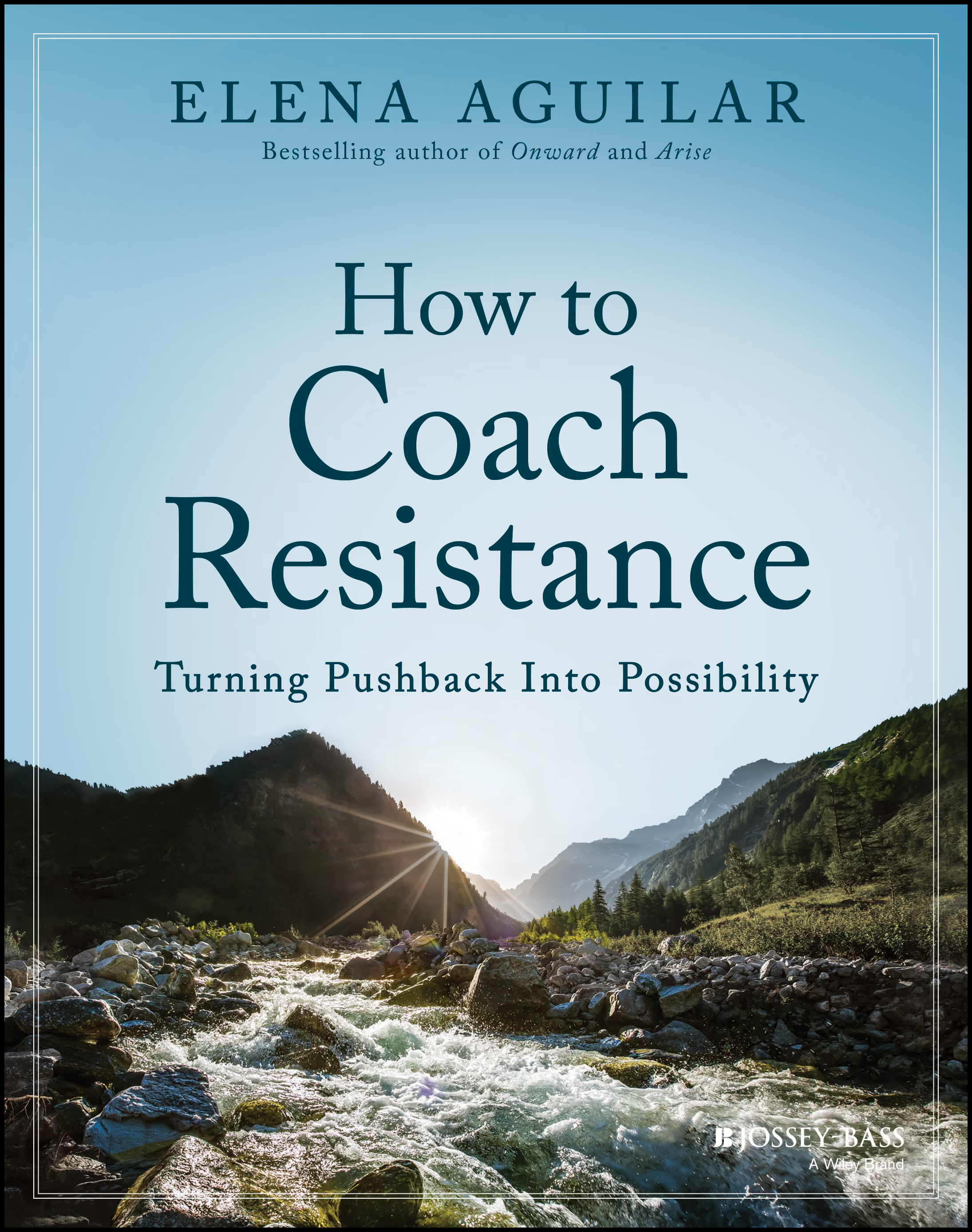
Here's a preview of the Introduction chapter of How to Coach Resistance (Elena Aguilar, Sept. 2026)
Not everything that is faced can be changed; but nothing can be changed until it is faced. -James Baldwin
Sandra always wore a baseball cap, pulled down low so that she'd have to lift her chin up high to make eye contact. The first time we met, at the August teachers' PD days, she sat in the back, arms folded, glaring at me from below her cap. Every time I asked the group to do something — jot down a few words in response to this question, turn and talk to your partner, pick a quote to respond to — she moved in slow motion, as if she was in a different dimension.
I noticed all of this, and told myself to ignore it, not to focus on her, to keep my voice steady. She was a seventh-grade English teacher, and I tried imagining her as a student — I didn't get reactive with students. But she was a grown-up. And for three days, I thought she did her best to communicate her dislike of me. Her not-wanting-to-be-there. Her devotion to not engaging. How else was I to interpret her loud and exaggerated sighs, or her one- or two-word answers?
I gave her space. I felt like she was just waiting to challenge me, so I didn't directly approach her or call on her — except for once, when someone needed a partner, and I saw that she didn't have one, and I said, "Sandra, would you mind partnering with ___?" At the end of those three long days, as I was gathering supplies and teachers were packing up, she approached me and said, "I really didn't like that you told me to partner with ___. I felt offended. I felt like you were treating me like a kid. Don't treat me like a kid."
I was tired and taken aback, and still I found some reserve of calm and said, "Thank you for that feedback. I'm glad you told me. That was not my intention." I doubt, however, that my tone communicated genuine gratitude. I was irritated.
I drove home that evening replaying the three days. Not the teachers who had engaged, asked questions, and welcomed me. But Sandra. I kept thinking about Sandra. I told myself that some teachers are just resistant and there's nothing you can do. I told myself I would figure out how to break her.
That was the goal I brought to my first full-time coaching position. Not to understand Sandra or find out what she needed, but to break her.
I feel a knot in my stomach as I write those words and show you who I was then.
What I know now, after twenty years of coaching educators and training coaches, is that the impulse to break someone is exactly what makes resistance worse. Resistance requires two forces: it emerges in the interaction between one person’s protection and another person’s push. When I was trying to break Sandra, I was supplying one of those forces.
I didn't know that yet.
Sandra and I battled for two years.
Our skirmishes took place in whole-group staff meetings, department meetings, and one-on-one coaching sessions. I dreaded seeing her. I was relieved when she was out sick. I alternated between resolving that I would figure out how to break her and wanting to hoist up my white flag and quit.
Sandra was not the only teacher at that middle school who did not want to be coached.
There was Kat, who wanted me gone. Kelly, a second-career first-year teacher who made it clear she thought she could do my job — and the principal’s — better. Jackie, who often dozed off in department meetings and rarely followed through. Mary, who told me she couldn’t be “made” to meet with me and would file a union complaint if I tried.
Very few of the teachers at that school wanted to be there. They openly disparaged the students they taught. They hated “the district.” They didn’t respect the principal. The assistant principal didn’t respect the principal either, or the students, or their families — and she made all of this known. I had walked into something I didn’t have a name for yet: a toxic organizational culture, years in the making, the accumulated sediment of resistance that had never been addressed.
To my colleagues at the school I’d left, and to other coaches, I’d bemoan the situation.
“I have never experienced resistance like this,” I’d say. “I have no idea what to do.”
This was my first full-time instructional coaching position. I had taught for twelve years, but I had no training as a coach and received no support that first year. My motto — which I kept to myself — was resistance is futile. This was a reference to the Borg from Star Trek: The Next Generation, who were trying to take over the universe and assimilate everyone.
I was determined to conquer resistance.
I was not successful with Sandra. Or with Kat, or Kelly, or Jackie, or Mary. I think I destroyed that possibility early on, in ways I didn’t yet have the awareness to see. But I learned so much about myself from working in this school. I saw unexamined aspects of my personality, gaps in my emotional intelligence, and patterns in the way I responded when I felt ineffective, afraid, or ashamed. I learned that my reactions were part of what made the situation so difficult, and I realized that I could influence more than I thought.
Keep reading. Download the full introduction.




Bright Morning Podcast